In 2026, finishing teams are being evaluated on two outcomes simultaneously: faster throughput and more consistent surface quality — while dust control requirements tighten and rework costs continue to climb. The pressure is real, and the abrasive choice is one of the few variables that affects both outcomes at once.
Traditional sandpaper fails in a predictable sequence. Dust from the workpiece packs into the spaces between abrasive grains. Cut rate drops. The operator compensates by pressing harder. Heat increases. Random deep scratches appear from debris dragged across the surface. The sanding session becomes a stop-start cycle of cleaning, changing sheets, and inspecting for defects — none of which is productive time. The abrasive is often discarded not because the grain is worn out, but because dust loading has made it ineffective.
Ceramic mesh addresses that failure mode at the source. It combines ceramic abrasive grain — engineered to self-sharpen during use — with a mesh structure that enables full-surface dust extraction across the entire abrasive face. The result is a cutting surface that stays cleaner and sharper for longer than traditional sandpaper, and in clogging-limited applications, that combination can realistically reduce sanding labor by 30 percent or more. This guide explains why the combination works, where it creates the most value, and how to specify it for your process.
The performance advantage of ceramic mesh over traditional sandpaper comes from two mechanisms working together. Understanding each one separately makes it easier to understand why the combination produces results that neither mechanism achieves alone.
Conventional abrasive grains — aluminum oxide, silicon carbide — wear by progressive dulling. The cutting edges round off under repeated contact with the workpiece surface. As the edges dull, the grain generates more friction and less cutting action. The operator feels the resistance increase and typically responds by pressing harder, which accelerates heat buildup and grain damage without restoring the cut rate.
Ceramic abrasive grain is engineered to behave differently. Under the mechanical stress of sanding, ceramic grains micro-fracture along controlled internal planes, shedding worn surface material and exposing fresh sharp cutting edges. This self-sharpening mechanism is not random grain breakdown — it is a designed wear behavior that continuously renews the cutting surface throughout the abrasive's usable life. The cut rate remains more stable from the beginning of the sheet or disc's life to near the end, rather than starting high and declining rapidly as the grain dulls.
For finishing operations where consistent scratch depth and surface texture are required — primer leveling, filler sanding, pre-finish wood preparation — that stability in cut rate translates directly into more consistent surface quality across a part or a batch.
Self-sharpening grain addresses one side of the abrasive failure problem. The other side is dust loading, and this is where the mesh structure makes its contribution.
Traditional sandpaper has a solid backing with abrasive grain bonded to the surface. Dust generated during sanding has limited escape routes — it either falls away from the surface, is captured by extraction through a small number of holes in the disc, or packs into the spaces between grains. On materials that generate fine, adhesive dust — drywall compound, automotive filler, primer, resinous wood — packing happens quickly. The loaded abrasive surface no longer cuts cleanly. It drags debris across the workpiece, generating heat and producing the random deep scratches that are the most common cause of rework in finishing operations.
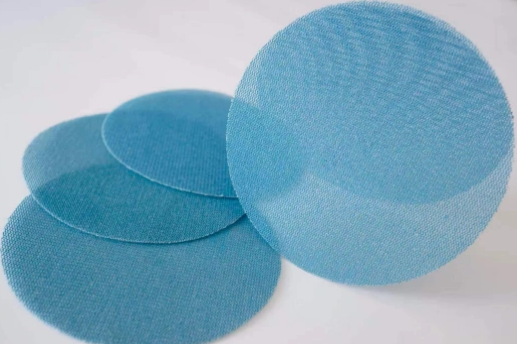
Mesh construction eliminates the solid backing that traps dust. The open mesh structure allows dust to pass through the abrasive surface continuously, across the entire face of the disc or sheet — not just through a few extraction holes. When paired with vacuum-assisted sanding, the airflow through the mesh removes dust from the cutting zone in real time, keeping the grain exposed and the cutting action consistent. Even without active extraction, the open structure reduces the rate of dust accumulation compared to solid-backed paper.
The reason ceramic mesh outperforms both ceramic-on-paper and mesh-with-conventional-grain is that the two mechanisms reinforce each other. Ceramic grain self-sharpens to maintain cutting edges. Mesh construction keeps those cutting edges clean by evacuating dust before it can pack between grains. The result is a cutting surface that is both sharp and clean throughout the abrasive's usable life — not just sharp at the start before loading begins, and not just clean if the grain were already dull.
In clogging-limited applications — the majority of finishing work on primers, fillers, and soft materials — the combination removes the two primary causes of premature abrasive failure simultaneously. That is why the labor reduction in these applications is not incremental. It is structural: fewer sheet changes, fewer cleaning interruptions, fewer rework cycles from scratch defects, and more consistent throughput from start to finish of a sanding session.
Specifying ceramic mesh correctly for a production environment requires understanding the variables that affect how the self-sharpening and dust extraction mechanisms perform in practice.
The grit selection determines the balance between material removal rate and surface finish quality at each stage of the sanding process. Coarser grits deliver faster leveling on high-build fillers, primers, and rough wood surfaces. Mid-range grits blend and refine the surface texture left by the coarser step. Fine grits prepare the surface for coating or polishing with a controlled, shallow scratch pattern.
The goal in specifying a grit sequence is to use the fewest steps that still achieve the required surface condition. Each additional step adds time and abrasive cost. A well-designed two-step sequence — leveling and refinement — covers most finishing applications. A three-step sequence is appropriate when the starting surface condition is rough and the finish requirement is tight. Standardizing the grit sequence per substrate and application type reduces operator variability and makes consumption tracking meaningful.
The openness of the mesh structure determines how effectively dust is evacuated from the cutting zone. A more open mesh allows higher airflow through the abrasive surface, which is particularly valuable on materials that generate fine, adhesive dust — automotive body filler, drywall compound, primer, and resinous softwoods. On these materials, the difference between adequate and excellent dust evacuation is the difference between a disc that lasts through a full panel and one that loads within the first few passes.
Mesh openness should be matched to the dust characteristics of the substrate. For coarser, less adhesive dust — bare hardwood, for example — a moderately open mesh provides sufficient evacuation. For fine, sticky dust from fillers and primers, maximum mesh openness combined with active extraction delivers the most consistent performance.
The mesh structure needs to maintain its integrity under the mechanical stress of sanding, particularly at the edges where the disc or sheet contacts corners, transitions, and high-pressure contact zones. Edge breakdown — fraying or tearing at the perimeter of the disc — ends the abrasive's useful life prematurely and can introduce debris into the cutting zone.
For hand sanding and block sanding applications, tear resistance at the edges is the primary backing requirement. For machine sanding with a DA or random orbital sander, the backing needs to maintain consistent contact with the pad interface across the full face of the disc. Selecting the correct disc or sheet format for the tool and application pressure is part of ensuring that the mesh structure performs as designed.
Ceramic mesh delivers its full performance advantage when paired with vacuum-assisted sanding equipment that draws airflow through the mesh structure continuously. The pad interface — hook-and-loop attachment, pad hardness, and extraction port alignment — determines how effectively the vacuum system works with the mesh abrasive.
A worn or contaminated pad reduces both the mechanical contact between the abrasive and the workpiece and the extraction efficiency through the mesh. Replacing worn interface pads as part of regular maintenance is a straightforward step that protects the performance investment in ceramic mesh abrasive. For operations without vacuum extraction, ceramic mesh still reduces loading compared to solid-backed paper, but the full benefit of full-surface dust evacuation is only realized with active airflow.
Ceramic mesh creates the most significant performance difference in applications where dust loading is the primary cause of abrasive failure and rework. These are the applications where the 30 percent or greater labor reduction is most achievable.
Automotive body filler, drywall joint compound, high-build primer, and putty are the materials where traditional sandpaper fails most quickly and most predictably. The dust generated by these materials is fine, soft, and adhesive. It packs abrasive surfaces within the first few passes, causing cut rate to drop sharply and scratch quality to deteriorate. Operators on these materials typically change sheets far more frequently than the grain wear would require — they are changing because of loading, not because the abrasive is spent.
Ceramic mesh on these materials keeps the cutting surface clean through continuous dust evacuation, and the ceramic grain maintains its sharpness through self-sharpening. The combination extends the effective cutting life of the abrasive significantly, reduces the frequency of sheet changes, and eliminates the random deep scratches from loaded abrasive that require rework. Resinous softwoods present a similar loading challenge, and the same mechanism applies.
In automotive refinishing, the scratch pattern left by the sanding step determines how much compounding and polishing work is required to achieve the final surface quality. An inconsistent scratch pattern — caused by a loading abrasive that cuts unevenly — requires more compounding passes to level, which adds time and increases the risk of cut-through on edges and high spots.
Ceramic mesh produces a more consistent scratch pattern because the cutting surface remains cleaner and sharper throughout the sanding pass. The downstream compounding and polishing steps are faster and more predictable, and the rework rate from surface quality variation decreases. For refinishing operations running volume work, that consistency compounds into meaningful labor savings across a shift.
Large surface area sanding on cabinet doors, panels, and furniture components is a high-consumption application for abrasives. The combination of wood dust, resin, and finish residue creates loading conditions that shorten the effective life of traditional sandpaper significantly. On a production line running volume, the cumulative cost of frequent sheet changes — abrasive cost plus changeover time — is a meaningful number.
Ceramic mesh reduces loading on wood surfaces, extending the effective cutting life per disc or sheet and reducing changeover frequency. The more consistent cut rate also produces more uniform surface texture across large panels, which reduces the touch-up and rework that surface variation generates before coating.
Achieving the labor reduction that ceramic mesh makes possible requires matching the product specification to the application and setting up the process to capture the dust extraction advantage.
Start by identifying the substrate and the primary failure mode in the current sanding process. If the answer is clogging and loading — frequent sheet changes, cut rate that drops within the first few passes, random deep scratches from debris — ceramic mesh addresses that failure mode directly. If the answer is grain wear on a hard substrate, the mesh structure is less critical and the ceramic grain specification is the primary variable.
Confirm the format requirement based on the tools and part geometry in use. Disc format for DA and random orbital sanders, sheet format for hand sanding and block sanding, and custom-cut formats for specific fixtures or line applications. The format should match the tool pad hardness and the application pressure to ensure consistent contact across the abrasive face.
Set a grit sequence that minimizes passes while meeting the surface specification. Test the sequence on a representative part before committing to production volume. Measure time-to-finish and inspect the scratch pattern under raking light to confirm that the surface condition meets the requirement for the next process step.
Validate the selection with a timed trial. Measure minutes per panel or part, number of abrasive changes per batch, and rework rate from scratch defects. Compare against the same metrics from the current abrasive. The trial data gives procurement a cost-per-finished-area figure that is specific to the operation and defensible in a budget review.
Use vacuum extraction when available. The full-surface dust extraction benefit of ceramic mesh is most fully realized when active airflow draws dust through the mesh structure continuously. Even a basic vacuum-assisted sander delivers significantly better dust evacuation than extraction through a few holes in a solid-backed disc.
Keep interface pads clean and replace them when worn. A contaminated or deformed pad reduces both mechanical contact and extraction efficiency. Pad replacement is a low-cost maintenance step that protects the performance of the abrasive.
Standardize pressure and stroke patterns across operators. Ceramic mesh performs most consistently when the operating conditions are stable. Variable pressure between operators produces variable results and makes it difficult to measure the abrasive's actual performance in a meaningful way.
The cost argument for ceramic mesh is built on cost per finished area, not cost per disc or sheet. Making that argument credible requires measuring the right variables before and after the switch.
The three primary sources of ROI from ceramic mesh are fewer abrasive changes, faster cut due to reduced loading, and lower rework from scratch defects. Each of these has a measurable labor cost component that does not appear in the abrasive unit price comparison.
Fewer abrasive changes means less downtime per shift. Each changeover — stopping the sander, removing the worn disc, attaching a new one, resuming the pass — takes time that accumulates across a production day. If ceramic mesh reduces changeover frequency by half on a clogging-limited application, the labor saving per shift is real and calculable.
Faster cut due to reduced loading means more surface area finished per hour. If the abrasive maintains its cut rate for longer because the mesh keeps it clean, the operator finishes more panels or parts in the same time. That throughput improvement is the primary driver of the 30 percent labor reduction target in clogging-limited operations.
Lower rework from scratch defects means less time spent on touch-up and re-sanding after the initial pass. Random deep scratches from loaded abrasive are one of the most common causes of rework in finishing operations, and they are directly traceable to the loading failure mode that ceramic mesh addresses.
Track cost per square meter or square foot of finished surface — total abrasive spend divided by total surface area finished. Track labor minutes saved per batch compared to the previous abrasive. Track abrasive units consumed per shift. Track dust-related cleanup time and any compliance incidents if dust control is a regulatory requirement in the facility. These four metrics give management a complete picture of the cost difference that unit price comparisons miss.
Traditional sandpaper fails in finishing operations not because the grain wears out, but because dust loading turns a sharp abrasive into a clogged, scratch-prone surface long before the grain is spent. Ceramic mesh solves both sides of that problem simultaneously. The ceramic grain self-sharpens to maintain cutting edges throughout the abrasive's usable life. The mesh structure enables full-surface dust extraction to keep those cutting edges clean. Together, the two mechanisms eliminate the primary causes of premature abrasive failure in clogging-limited applications — and the result is a structural reduction in sanding labor, not an incremental improvement.
For finishing operations running fillers, primers, drywall compound, resinous wood, or automotive refinishing work, the combination of self-sharpening grain and full-surface dust extraction is the most direct path to fewer changeovers, more consistent surface quality, and a cost-per-finished-area outcome that justifies the switch from traditional sandpaper.
To receive a recommended grit sequence, format specification, and quotation, visit the CG-V ceramic mesh product page and submit the following details:
Operating conditions: material or coating type (filler, primer, wood, paint, drywall compound), dry sanding with or without extraction, tool type (DA sander, hand sanding, block), pressure level
Quantity: monthly usage volume, per-project demand, trial versus bulk order
Size and specs: disc or sheet size, hole pattern if applicable, hook-and-loop requirement, grit range and number of steps
Target metrics: time reduction target, finish standard expressed as Ra or appearance grade, defect rate goal, dust control requirement
Current problems: clogging and loading, frequent sheet or disc changes, random deep scratches, inconsistent finish quality, high cleanup time
Q1: What is ceramic mesh?
Ceramic mesh is a mesh-structured abrasive that uses ceramic grain bonded to an open mesh backing rather than a solid paper or film backing. The mesh structure allows dust to pass through the abrasive surface continuously during sanding, reducing the loading and clogging that cause traditional sandpaper to fail prematurely. The ceramic grain provides self-sharpening cutting action that maintains cut rate throughout the abrasive's usable life. The combination is designed for finishing applications where dust loading is the primary cause of abrasive failure and rework.
Q2: What is the main difference between ceramic mesh and traditional sandpaper?
Traditional sandpaper uses a solid backing that traps dust between abrasive grains, causing loading that reduces cut rate and produces random deep scratches. The abrasive is often discarded before the grain is worn out because loading has made it ineffective. Ceramic mesh uses an open mesh backing that allows full-surface dust evacuation, keeping the grain exposed and the cutting action consistent. The ceramic grain adds self-sharpening behavior that maintains sharp cutting edges as the abrasive wears. Together, these two differences address the two primary failure modes of traditional sandpaper simultaneously.
Q3: What is the ROI of switching to ceramic mesh, and how is the 30 percent labor reduction achieved?
The 30 percent or greater labor reduction is achievable in clogging-limited applications — those where the current abrasive is being changed primarily because of loading rather than grain wear. The reduction comes from three sources: fewer abrasive changes per shift, faster cut rate due to reduced loading, and less rework from scratch defects caused by loaded abrasive. The best way to validate the reduction for a specific operation is a timed trial measuring minutes per part, changeover frequency, and rework rate before and after switching to ceramic mesh. The cost-per-finished-area figure from that trial is the most defensible basis for the procurement decision.
Q4: Do we need new tools to use ceramic mesh effectively?
No new tools are required to use ceramic mesh. It is compatible with standard DA sanders, random orbital sanders, and hand sanding applications using hook-and-loop pads. To capture the full benefit of full-surface dust extraction, vacuum-assisted sanding equipment is recommended — the airflow through the mesh structure is most effective when active extraction draws dust away from the cutting zone continuously. Without extraction, ceramic mesh still reduces loading compared to solid-backed paper, but the maximum performance benefit is achieved with active airflow. Replacing worn interface pads before switching is a straightforward step that ensures consistent contact and extraction efficiency.
Q5: What parameters should we provide for accurate selection and quoting?
For the most useful recommendation, provide the substrate or coating type being sanded, the sanding method (DA sander, hand sanding, or block sanding), whether vacuum extraction is available, the required grit sequence or the starting and finishing surface conditions, the disc or sheet size needed, the target finish level expressed as Ra or appearance grade, the monthly usage volume, and the primary problem currently being experienced — clogging, frequent changeovers, random deep scratches, inconsistent finish quality, or throughput below target. The more specific the inputs, the more accurate the grit sequence and format recommendation.